
How to Prepare for the Agentic Era: 4 Practical Takeaways for 2026
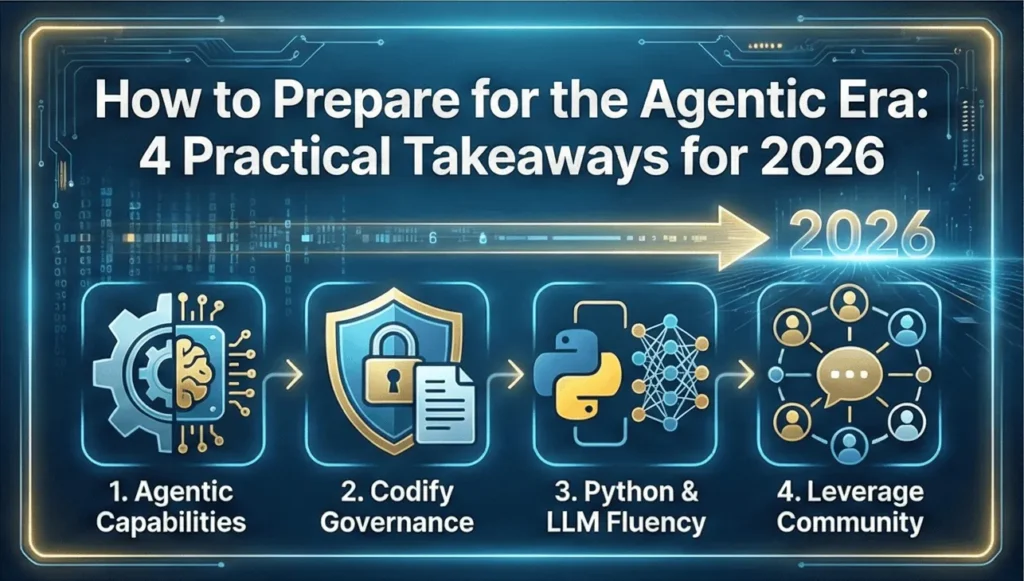
The data is clear: The industry is maturing. Here is your roadmap for January 2026.
In Part 1 of this Series, we unpacked the massive shifts revealed in the UiPath ‘State of the Agentic Automation Professional’ 2025 report — specifically the pivot to Agentic Automation and the undeniable rise of Python.
But knowing the trends is only half the battle. The real question is: What should we actually do differently starting in January 2026?
It’s not just about “more automation” — it’s about a fundamental shift in how we build. Based on the report’s data, here are my 4 practical takeaways for organizations and automation professionals who want to stay ahead of the curve.
1. Prioritize Agentic Capabilities
The toolset is changing, and our skill set must follow. The report flags tools like Agent Builder and Maestro as explicit areas of developer focus for 2025. This isn’t optional anymore. We need to invest time in mastering these platforms now.
Action Item: If you haven’t started playing with these yet, put them on your Q1 roadmap. Don’t wait for a client or stakeholder to ask for them.
2. Codify Governance Early
The data shows that security, privacy, and integration complexity are the top concerns for the coming year. This tells us one thing: Don’t wait for a bottleneck. Agentic workflows are more autonomous and complex than standard RPA. We need to address this proactively by establishing reference architectures and playbooks before we try to scale.
Action Item: Review your current governance model. Does it account for autonomous decision-making agents, or is it still designed for linear bots?
Build Your 2026 Agentic Roadmap
Stop guessing and start scaling. Get expert guidance on Python orchestration, LLM integration, and agent governance.
3. Amplify Python + LLM Fluency
As I noted in the previous article, the gap between “traditional” RPA and AI engineering is closing fast. This is becoming our new baseline. It is time to create team learning plans that focus specifically on:
- Python-based agent orchestration.
- Multi-LLM integration patterns (ChatGPT, Gemini, Anthropic).
Action Item: Move beyond “calling an API.” Focus on understanding the orchestration patterns that stitch these models into coherent business processes.
4. Leverage the Community
With 89% of pros reporting a sense of belonging and high daily interaction, the UiPath Community is a massive, underused asset. Don’t just use the Forum for troubleshooting error codes, use it for internal team enablement. The collective intelligence of the community is often months ahead of official documentation.
Action Item: Encourage your team to participate in community events not just as attendees, but as active contributors to stay sharp.
Over to You… Which of these shifts is your team finding the most challenging? Is it the technical upskilling (Python/Agents), or is it the “boring” stuff like Governance?
Let me know in the comments — I’m curious to see where the friction points are.
Stay tuned for the next installment: Agentic Automation: 6 Data-Based Predictions for 2026.
You can download the full ‘State of the Agentic Automation Professional’ 2025 Report here.

As an automation consultant, digital transformation strategist, and delivery manager, I help organizations streamline operations and unlock agility by transforming manual processes into high-impact digital workflows. At dipoleDIAMOND, I lead automation initiatives with cross-functional teams to design and optimize solutions that improve efficiency, accuracy, and compliance while driving continuous improvement. I am also committed to community education and professional development, mentoring emerging practitioners, and contributing to initiatives that advance next-generation automation technologies.